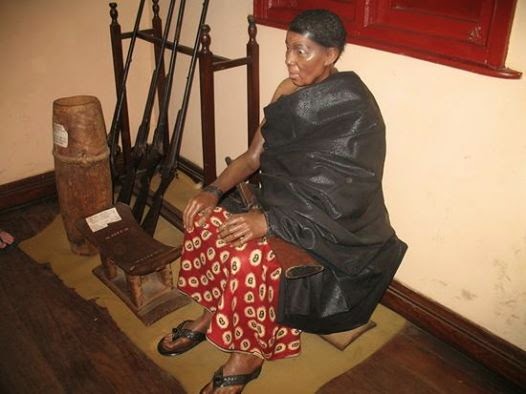
Yaa Asantewaa is one of the best-known figures in West African history. As Queen Mother of Ejisu she took command, in 1900 and past the age of sixty, of a rebellion against the British Empire after the Asante were told to surrender the Golden Stool. Her name — Yaa marks a girl born on a Thursday — has become shorthand for courage, women's leadership and resistance.
A Queen Mother of Ejisu
Born around 1840 at Besease, near Ejisu, she was appointed Queen Mother (Ejisuhemaa) by her brother, the chief of Ejisu. When he died in 1894 she put forward her own grandson as the new chief. In the matrilineal Asante system the Queen Mother holds real political and moral authority: she nominates the candidate for the throne (see Society & Matrilineality).
Besease today is known for its Yaw Tano shrine, one of the ten traditional Asante buildings designated a UNESCO World Heritage site in 1980 (see Culture & Architecture).
The Context: the Demand for the Golden Stool
In 1896 the British arrested Asantehene Prempeh I and his chief advisers and exiled them, first to Sierra Leone and then to the Seychelles. In 1900 Governor Sir Frederick Hodgson summoned the remaining chiefs to Kumasi and demanded the Golden Stool so that he could sit on it — a sacrilege, since the Stool embodies the nation's soul and never touches the ground or serves as a seat (see The Golden Stool).
The Speech That Changed Everything
At a secret meeting of chiefs, the men hesitated in the face of British military power. Yaa Asantewaa rebuked their fear: no foreigner would once have dared to speak to an Asante chief that way. If the men would not fight, she said, the women would.
"If you, the men of Asante, will not go forward, then we will. We, the women, will. I shall call upon my fellow women. We will fight till the last of us falls in the battlefields."
Yaa Asantewaa, 1900
The War of the Golden Stool (1900)
Named Commander-in-Chief, she mobilized a vast volunteer army. From March 1900 her forces besieged the British fort in Kumasi for about six months in intense guerrilla warfare. Historians stress that command was shared with other war leaders, notably General Asamoa Nkwanta; her role as mobilizer and symbol nevertheless remains central.
British reinforcements eventually prevailed. Yaa Asantewaa was captured and exiled to the Seychelles with other Asante leaders, and the Asante were formally annexed into the British Empire in 1902. Yet the rebellion achieved its essential aim: the British never captured the Golden Stool, which stayed hidden and inviolate.
Exile and Return
Yaa Asantewaa died in exile in the Seychelles on 17 October 1921. After his own return in 1924, King Prempeh I saw to it that her remains were repatriated for a royal burial befitting her rank.
Memory and Legacy
- Yaa Asantewaa Girls' Senior High School in Kumasi, founded in her honour in 1960.
- Yaa Asantewaa Museum at Kwaso (near Ejisu), opened on 3 August 2000 for the war's centenary; destroyed by fire in 2004.
- Yaa Asantewaa Festival: commemorative celebrations have been held, notably in 2000 and 2006.
- Today she is a Pan-African symbol of anti-colonial resistance and of women's authority.